You went to the gynaecologist. You had the ultrasound. She looked at the screen and said ma fi shay — nothing there, everything's clear.
And you left still exhausted. Still gaining weight you can't shift. Still waiting on a period that comes when it feels like it.
Here's what nobody explained to you in that room: a clear ultrasound does not rule out PCOS. Not even close.
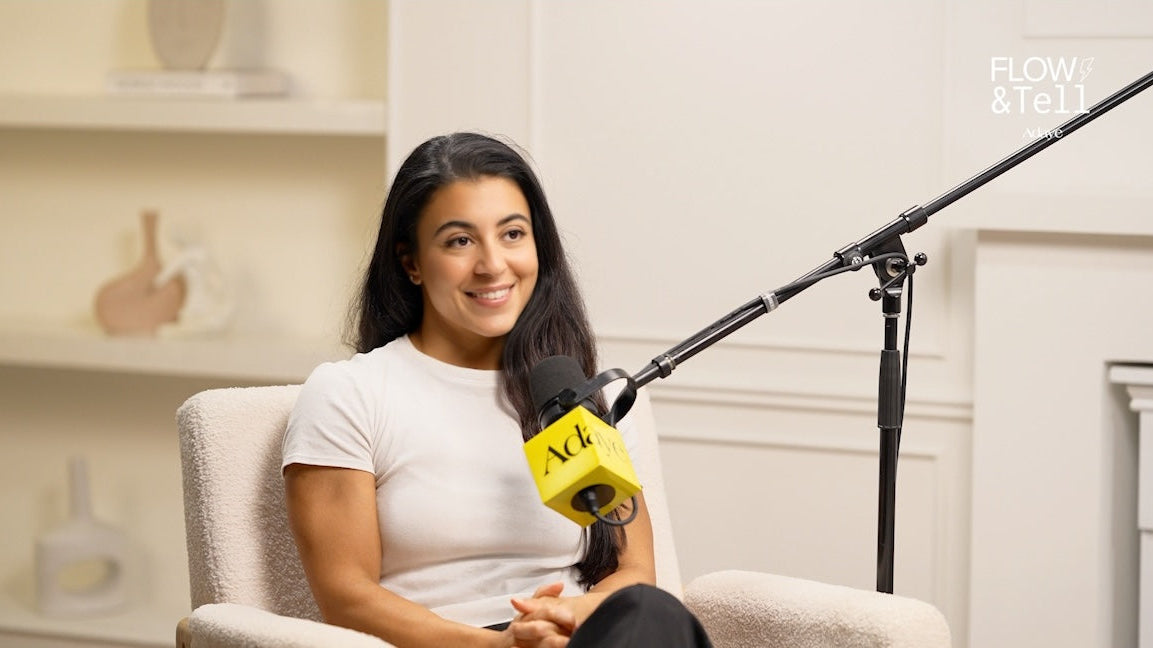
September is PCOS awareness month, so we sat down with Dr. Jawaher Kadhem, ND — the first Khaleeji naturopathic doctor, practising in Bahrain — for an episode of Flow & Tell about what this condition actually is, why so many women here have it without knowing, and what it takes to manage it properly.
Fair warning: some of this is going to make you want to book a blood test.
It has a new name now. And the new name explains everything.
PCOS — Polycystic Ovarian Syndrome — has been renamed PMOS: Polyendocrine Metabolic Ovarian Syndrome.
That is not a branding exercise. The old name told you it was an ovary problem. It never was.
"It's a hormonal condition, metabolic condition," Dr. Jawaher explains. "It affects multiple systems in the body and not just your ovaries."
So the new name pulls in the parts that were always there and never got named: insulin resistance. Weight that won't move. Energy that's gone. Excess androgens showing up as acne along your jaw, hair where you don't want it, hair loss where you do.
"It's not just periods," she says. "It's also how you look in the mirror. It's also energy."
Which means the person who spots it might not be your gynaecologist at all. It might be your dietitian, wondering why the plan isn't working.
One in three, not one in five
Globally, roughly one in five women are diagnosed with PCOS. In the Khaleej, Dr. Jawaher says the regional picture she works with is closer to one in three.
Why the gap? Partly genetics. But she's careful not to hand it all to genetics, because the rest of it is something we can actually do something about.
"Our lifestyle here definitely pushes towards insulin resistance," she says. "A lack of movement."
And food — though not in the way you'd expect.

The carb problem (it's not the ingredients)
Dr. Jawaher asks every patient the same question: what did you eat for lunch?
The answer is usually ghada al-Bahraini. Rice, protein, salata. On paper? Genuinely well-built. Whole grain, protein, vegetables.
"But then we look at portions."
Most of the plate is rice. The protein is a fraction of it. And the salata — the salata is an afterthought, sitting at the edge of the plate doing nothing.
"Ingredients-wise it's healthy," she says. "It's our portions."
This is the part we love, because it isn't a lecture about giving up your culture's food. It's a lecture about the ratio on the plate. More protein. More fibre. Treat the salad like it's part of the meal.
And no, she doesn't want you cutting carbs.
"Don't cut out carbs. Eat better carbs, complex carbs. When you're eating your carbs, how much are you moving?"
Two out of three. That's the whole test.
Here's the piece that changes how you should approach your next appointment.
To diagnose PCOS, a doctor is looking at three criteria — and you only need two of the three:
- Irregular cycles — most commonly cycles longer than 35 days (cycle days, not bleeding days)
- High androgens on a blood test — testosterone and other androgen markers
- Cysts on your ovaries, seen on ultrasound
Read that again. Your ovaries can be completely clear and you can still have PCOS, on the strength of the other two.
"A lot of women, they go, 'Can I just do an abdominal ultrasound with a gynaecologist?' And then the gynaecologist will be like, 'Yeah, everything's clear, you don't have PCOS.'"
That's how it stays undiagnosed for years.
The blood test your annual panel is skipping
Most standard annual panels check HbA1c — a three-month average of your blood sugar. Useful. But it's a diabetes and pre-diabetes marker.
It misses insulin resistance until, in her words, it's "a bit too late."
"We're not even checking for insulin on annual panels."
So if you're asking for tests: fasting insulin, alongside glucose and HbA1c. Plus androgens — total and free testosterone, DHEAS, SHBG. Vitamins and minerals. Inflammatory markers. Liver and kidney function.
She built a women's health panel with her lab in Bahrain for exactly this reason. And she asks every patient, female and male, to do comprehensive bloods once a year.
"For me, data is everything."
About the pill
If you've been handed birth control for irregular periods, you should know what the bleed you're getting actually is.
It isn't a period. It's a withdrawal bleed — an artificial one.
It works, and it works fast. Within a month you have a predictable cycle again, and for a lot of women that relief is real and shouldn't be dismissed.
But the underlying thing hasn't moved.
"This is what breaks my heart the most," Dr. Jawaher says. "You put young females on birth control that have these complaints, and then they want to get pregnant, so they stop the birth control, but they never solved what got them there in the first place."
Ten years later, off the pill, trying to conceive — and you're back at zero.
The three-month reset
The naturopathic route is slower. She's upfront about it: three to six months before real results, because you're changing habits, not swallowing a fix.
She starts every patient with the same question. Are you ready to work with me?
Then she builds from the foundations, in this order:
- Nourishment — what you're eating, what you're under-eating, your relationship with food
- Movement — consistency over perfection. Not marathons.
- Sleep — quality, not just hours. Are you actually waking up rested?
- Stress — how you cope, and what tools you have
- Community — do you feel supported? Do you feel safe?
- Sunlight — time outside, green space, a real 24-hour rhythm
Only then do the a'shab and supplements come in.
And critically: one habit at a time. One new thing every one to two weeks. More veg in this week's grocery run. A 30-minute walk next week. Protein awareness the week after.
"How we get to that three-month mark is small habits that we compound."
The stress you can't feel
One of the biggest contributors she sees is stress — and not only the psychological kind.
"Our body is exposed to many, many things in our modern environments. Things we put on our skin, our skincare products, things we use to clean the house, menstrual care products, things we cook with."
Every one of those carries a chemical load your liver has to process. Day in, day out.
"A huge component of PCOS is lessening that load."
Which is, honestly, the whole reason Adaye exists. You wear a period product against one of the most absorbent areas of your body, for about a week a month, for decades. It's one of the easiest swaps on that list — you make it once, and it keeps paying you back.
100% organic cotton. No plastic. No fragrance.
On supplements — please don't freestyle this
Dr. Jawaher's list, roughly:
- Vitamin D3 for insulin signalling — which only works properly with enough magnesium in your blood. Start there before anything exotic.
- Myo-inositol — heavily studied for cycle regulation, insulin signalling, and healthier testosterone levels.
- Vitex — kaf maryam. It grows in Bahrain, though it needs frost to fruit and doesn't berry here. Used for progesterone support and cycle regulation.
- Omega-3 — anti-inflammatory, and PCOS is inflammation-driven.
- Saw palmetto and zinc for high testosterone.
Now the caution, which matters more than the list. She also uses licorice root — and won't give it to everyone, because it can raise blood pressure.
Beyond that: supplement quality in this region is, in her words, horrendous. And the dose printed on the bottle is frequently not the therapeutic dose.
"Just because the bottle says take one cap, you may need three."
There is also no single PCOS protocol. Someone trying to conceive needs something completely different from someone whose main goal is weight loss — and some things aren't safe while trying to conceive at all.
So: get guidance. This list is context for a conversation with a practitioner, not a shopping list.
What we want you to take from this
PCOS is lifelong. It's managed, not cured. Cysts may shrink, symptoms can settle, and after menopause the androgen picture often eases — but the plan is a long one.
That isn't the bad news. The bad news is how many women are years into it without a name for what's happening.
So: a clear ultrasound is not a clean bill of health. Ask for androgens. Ask for fasting insulin.
Track your cycle days. Beyond 35 is information, not a personality trait.
If you're on the pill for PCOS, ask what's being treated — the symptom or the cause.
Start with one habit. Not twelve.
Because the girl who was told ma fi shay and sent home deserved more information.
So do you.
Want to take control of your PCOS with us?
Our 3 Month PCOS/PMOS Reset Challenge starts this September. Weekly naturopathic guidance from Dr. Jawaher, Clue Plus free for the duration, and a year of Adaye period care for every woman who finishes. [Join the challenge →]
About Dr. Jawaher Kadhem, ND
Dr. Jawaher is a Naturopathic Doctor specialising in integrative health care with a focus on hormones and gut health. Combining a passion for natural medicine with an evidence-based approach, Dr. Jawaher helps individuals better understand their bodies and achieve optimal health through personalised care. She is the first Khaleeji naturopathic doctor and practises in Bahrain out of her clinic Sidra Healing.

This article is for education, not diagnosis. Nothing here replaces a consultation with your own doctor — please don't start or stop any treatment based on a blog post.