Last week I had a uterine polyp removed. I posted about it because that’s what I do — I share, I advocate, I believe that when one woman knows more, we all know more.
What I didn’t expect was the flood of DMs.
Women wishing me well. Women asking who my doctor was because they were going through the same thing. Women who had questions, and stories of their own, and nowhere to share them.
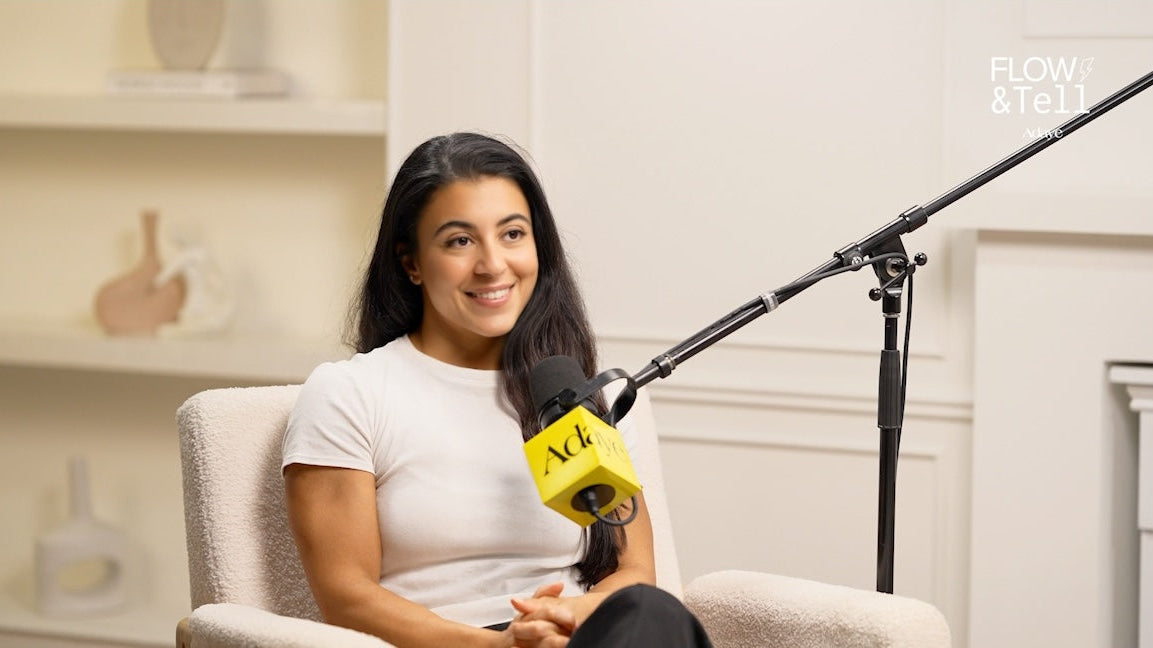
One conversation in particular — a back and forth with a girl trying to figure out her own symptoms — made me think: I should record a podcast about my period journey. And then she said: you totally should. And then I thought: why don’t I?
So here it is.
It Started at 9 (And That Wasn’t Normal)
I’ll never forget it. It was Ramadan. We were in Bahrain. We’d just eaten iftar from McDonald’s — chicken nuggets, obviously — came back home, I went to the toilet, sat down, and there was blood everywhere.
I was 9 years and 10 months old.
That is not a typical age for a first period.
My mom rushed me to the gynecologist, and they put me on the pill almost immediately — not for contraception, but to regulate hormones that were clearly all over the place. For the first few months, I was getting my period twice a month. Every two weeks.
I didn’t understand any of it then. But years later, I watched a documentary called Food Inc. — the one about hormones in animals and processed food — and it all clicked. The McDonald’s wasn’t just nostalgia. The hormones in that food, fed to a 9-year-old body, likely contributed to what my body was doing.
My mom didn’t know. Nobody really talked about it in the Gulf in the early ‘90s. They thought they were giving us something special. They were.
University, London, and “Nobody Has an Answer for You”
Eventually my periods regulated. But in university, something new started: spotting between my periods.
I was regular. Always on time. But I’d randomly spot in between, and I knew it wasn’t right. I saw doctors in London. I saw doctors in Bahrain when I moved back. I saw doctors in Dubai. And I got a different answer from each one.
At 22, a doctor in Dubai recommended a cervical erosion — a procedure where they freeze the cervix to clear out what’s causing the bleeding. I did it.
To this day, I still spot between my periods.
But something else came out of all of that: I built a habit. Every 6 months, I see a gynecologist. Not because something is wrong. Because something might be.
27: The Word “Fibroids”
When I was around 27, a doctor identified something for the first time: fibroids. Benign tumours that can grow in or around the uterus.
“Nothing to worry about,” she said, “until they become a problem.”
I’d come in every 6 months and monitor. Half a centimetre. One centimetre. Two. Three. Slow, steady, manageable.
And then, at some point, it became a problem.
The 4-Month Pregnancy I Didn’t Know I Had
One of my fibroids grew to 5 centimetres. Then 8. Another hit 5. I had multiple others sitting at 2 and 3.
I was training in the gym one day and had to stop running. Just had to stop — there was this aching pain I’d never felt before, and suddenly the weight of what was happening in my body became very literal.
“Shereen, you’re walking around with the equivalent of a 4-month pregnancy. Two fibroids, combined, the size of a 4-month fetus. Why are you walking around with a 4-month pregnancy?”
My periods, which had always been heavy — like, checking-my-chair-before-I-get-up heavy, change-my-tampon-every-hour heavy — were now impossible. I was planning my entire day around them.
I agreed to surgery.
140 Grams of Fibroids (What That Looks Like)
I was 33. The operation was scheduled to end around 5 PM.
I woke up at 8 PM.
The operation was so complex it ran 3 hours over. When I debriefed with my doctor afterward, she showed me a photo: a plate with all the pieces. Twelve fibroids. 140 grams of tissue pulled out of my body.
“This looks like a chicken meal,” I remember thinking. Because it did. White, muscular, dense. A chicken meal’s worth of growths that had been living inside me.
The recovery was the hardest thing I’ve experienced from any procedure. I couldn’t lift myself up for a week. Getting in and out of a car was genuinely difficult. I kept thinking about C-section mums — getting up, caring for a newborn, when I could barely sit upright.
I also got an infection, which pushed my total downtime to about 8 weeks.
When I came back to the gym, I told myself: 80%. Not from scratch, but not full throttle either. 80% of where I left off — and that was completely doable.
Egg Freezing: The Surprisingly Easy Chapter
My doctor, after the fibroid surgery, basically told me: yalla, get pregnant — fibroids can come back, so move fast.
I wasn’t married. But I was 34, and more and more of my friends were freezing their eggs. So I thought: why not?
It aligned perfectly with my cycle timing. It was Christmas (no traffic to the clinic). I took it as a sign.
The process typically takes 12–14 days. My eggs, apparently, are ambitious. We wrapped it up in 8 days. The operation was on New Year’s Eve. They retrieved 12 eggs, discarded 2, froze 10.
The only day I really felt the hormones was the morning of the procedure — woke up in significant cramping pain, very aware of every part of my body. For the week after, I was quite bloated. But honestly? Much easier than I expected.
(During that ultrasound, the doctor spotted a polyp. She said deal with it separately. That polyp took 3 years to remove — because the next doctor I switched to couldn’t find it, or wasn’t convinced it was there.)
Last Week: The Polyp That Took 3 Years to Remove
When I finally got it out — last week, at 37 — it turned out to be 2 centimetres, not the 1 centimetre she’d been measuring. A good thing we moved when we did.
The recovery was more painful this time. Cramps for a full week. That gushy, watery discharge (not period blood — just what happens post-procedure). And I genuinely didn’t want to work out, which almost never happens. My body was telling me to let things settle.
Maybe it’s age. Doing this at 31 versus 37 is a different experience.
The Thread Running Through All of It
For most of my twenties and early thirties, I was seeing a naturopath alongside my gynecologist. She passed away recently, and I think about her often — because she genuinely transformed the way I understand my body.
She was the one who connected my fibroids to estrogen metabolism. Not just estrogen levels — my levels were actually balanced — but how my body was processing and clearing estrogen. She was the one who started asking about my environment: the chemicals in my skincare, my haircare, my perfume, my detergents. My period care.
She recommended the Dutch test. She talked about gut microbiome — how that’s where estrogen metabolises, how fibre matters not just for nutrition but for how your gut bacteria function, how that affects everything downstream.
It’s never just one thing. Organic period care alone doesn’t fix it. Eating well alone doesn’t fix it. It’s a holistic picture — lifestyle, environment, what you put in and on your body, how your gut is functioning.
I still get these growths. But I genuinely believe that if I were still living the way I was at 8 years old, eating what I was eating, using what I was using, it would be so much worse.
What I Want You to Take From This
Go see your gynecologist. Every 6 months. I know that in this region, if you’re not married, people assume there’s no reason to go. There is. They can do external scans — nothing invasive. You deserve to know what’s happening in your own body.
If you have a polyp: get it removed. Day case, in and out, faster recovery than you think.
If you have fibroids: monitor them. But the moment they start affecting your training, your daily routine, your quality of life — that’s your sign.
And if you’re considering egg freezing and on the fence — mine was one of the easier things I’ve done.
I don’t think I’ve had my last operation. My body makes these things. But I understand it so much better now than I did at 9, standing in a bathroom in Bahrain, completely shocked.
That girl deserved more information. So do you.
x Shereen