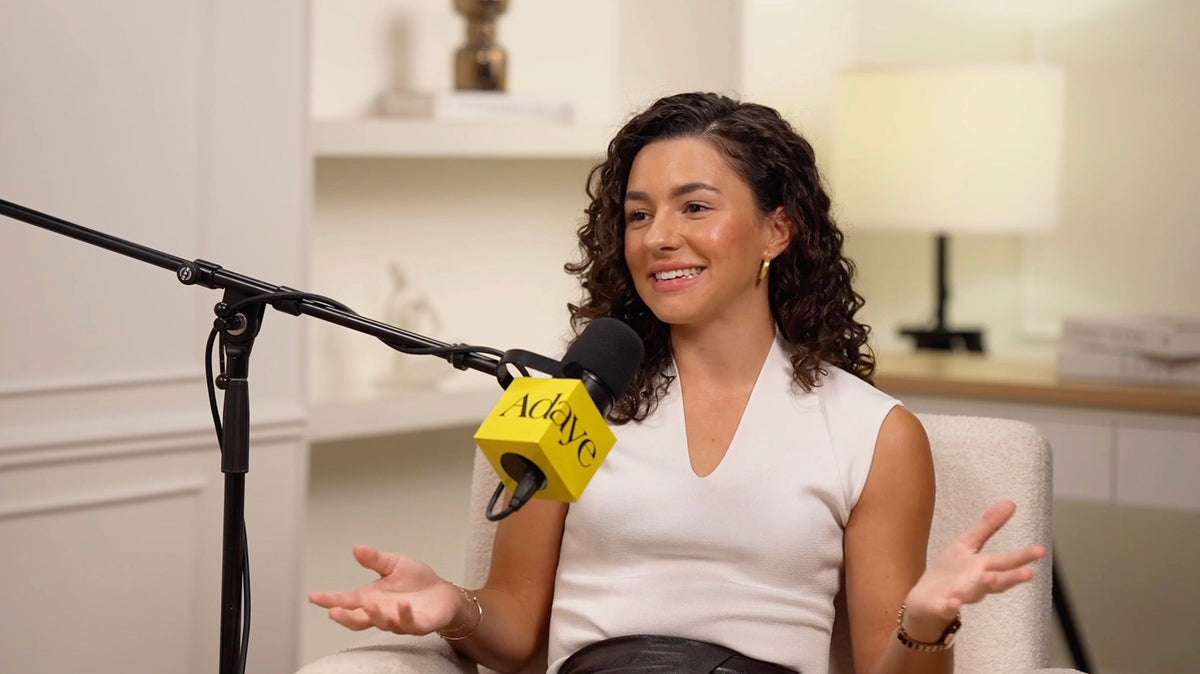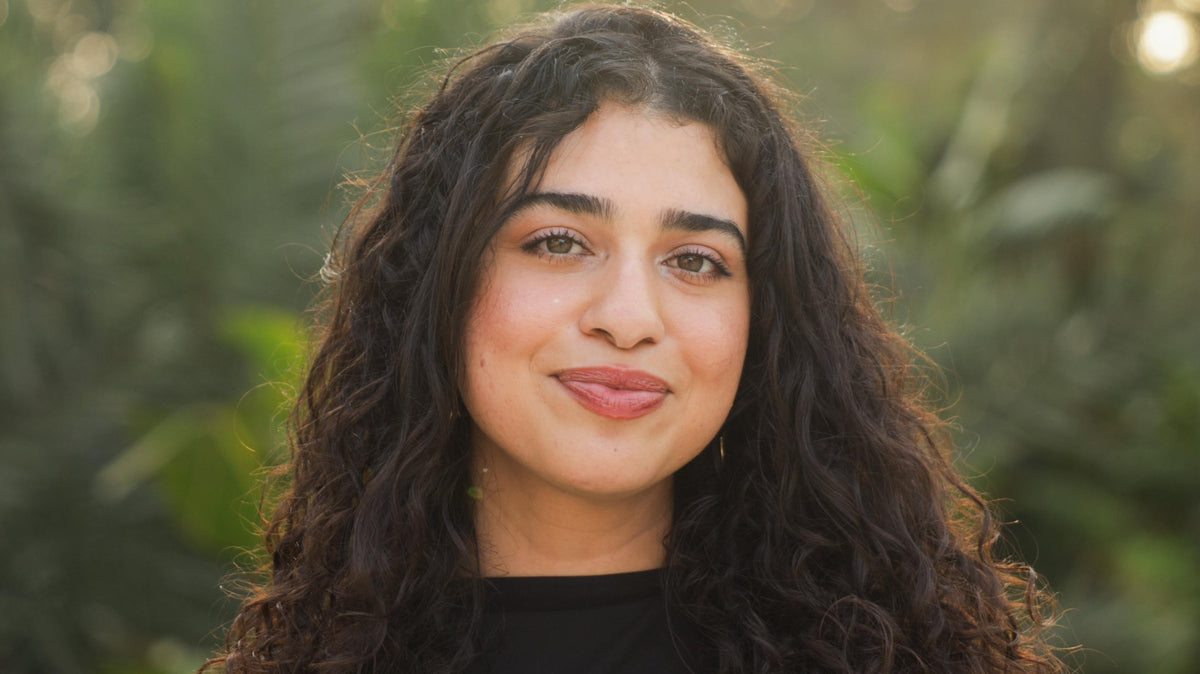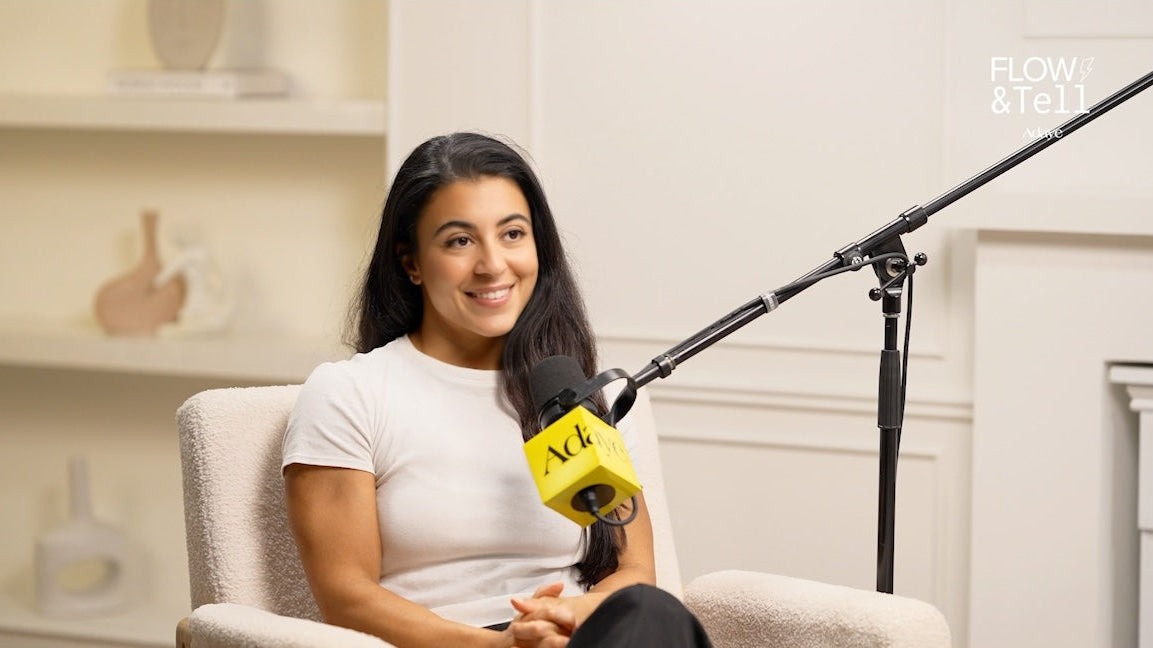
If you've spent any time on adaye.co, you've seen Andrea. She's been one of our ambassadors for the past year, and she's very graciously let us into her story along the way.
She teaches barre in Dubai. She moved here two years ago with one suitcase, the same week Adaye launched, which makes us Dubai twins.
What you might not know is how she got here. A fall that nearly killed her at four. A comeback in a dance studio where she was years behind everyone her age. And a stretch of her teens where her period just stopped showing up, and she thought that was a good thing.
So we sat her down for an episode of Flow & Tell.
Two cultures, three older sisters
Andrea's parents left Bosnia for the States in the '90s with her three older sisters. She came later.
"I'm like the American dream child."
She grew up in upstate New York in a proud Bosnian family, which meant living between two cultures that couldn't be more different, and never quite feeling like enough of either. It also meant growing up with a very particular kind of drive.
"If they went through all of this hardship and all this trauma, everything should be easy for me. If my parents did that, I can do this."
She admits that might not be the healthiest mindset. It's also what got her through everything that came next.
Two storeys down
Andrea started dancing at three, following her sisters into the studio.
At four, her family took their first trip back to Bosnia after the war. While visiting relatives, she slipped from a second-floor balcony and fell two storeys onto concrete.
She was diagnosed with an epidural hematoma, bleeding between the skull and the outer layer of the brain, and was rushed to Zagreb for emergency surgery that same day. Years later, her neurologist in the States told her that if she'd arrived even 15 minutes later, she wouldn't have survived.
She spent around 25 days in hospital, mostly alone, in a country where she barely spoke the language. When she left, she was in a stroller. For a four-year-old with endless energy, being told to sit still was its own kind of hard.
She was one of the lucky ones. No lasting effects, just a thin scar where the hair doesn't grow. But it kept her out of dance for years.
Level one at eleven
Andrea went back to dance at 10 or 11, into a pre-professional programme built on ballet technique.
Girls her age were in level four. She was at level one. And she was tall, so she looked even older than she was.
"That was traumatizing."
Dance isn't just strength. It's turnout, flexibility, technique, picking up choreography fast, stage presence. She had to build all of it from scratch, in the middle of puberty, while trying to fit in.
So she did what she does: she focused. By her late teens she was dancing with her level and with girls older than her.
There was another kind of noise to block out, too. People talked. Once, in the grocery store, someone her mum knew looked straight past Andrea and asked whether she was "normal."
She was an A+ student in honours classes. She went on to finish her degree in three years instead of four and got into a top PA school in the US. The noise was never the truth.
Why barre, not ballet
Andrea studied biology and always assumed she'd go into medicine like her sisters. Dancing professionally would have meant huge sacrifices, and her parents wanted her to have something safe.
But she couldn't give up movement entirely. At university she started her own dance club, the first of its kind there, and ran it for all three years, teaching peers who had never danced before.
Then she tried barre, got certified, and realised it was the place where everything she loved came together.
"Ballet, you need a lot of technique, and there's so many things that need to be almost perfect. I love that barre is accessible to anyone. My mom can do it."
(And if you've ever done her class, you'll know the soundtrack is a lot more Kanye than Tchaikovsky.)
The period that showed up on holiday
Andrea got her first period at 13, on a family holiday in the Caribbean. She knew her sisters got theirs, but it had always felt like something very far away.
"At the time, it was traumatizing. But looking back, I couldn't have been in a better place."
Her oldest sister, already in the medical field, took over. Breathe. You're okay. Here's how a pad works. Her mum and sisters gathered round, and her dad was politely asked to give the girls some space.
Leotards, pink tights and black shorts
Ballet comes with a uniform: a leotard, pale pink tights, and nowhere to hide.
So on your period, you'd put your pad or tampon on, pull your tights over, add the leotard, and then a pair of black shorts on top, just in case of a leak.
Which meant the whole class knew.
Add costume changes and performances, and periods became one more layer of stress on top of an already intense schedule.
Months without a period
As a teen dancer, Andrea was training five days a week, two to four hours a night after school, and all weekend around performances. And she'd go months without a period.
"Honestly, at the time, I thought that was good. I thought that meant I was training at the highest level."
Her doctor put it down to a new cycle that hadn't settled yet. That was true at the start. But it carried on into her late teens.
It wasn't until she studied biology at university that it clicked.
"I was putting so much energy into my training that my body didn't have the energy to start my menstrual cycle."
She was eating well. A Balkan mum at the stove morning and night made sure of that. She was simply training harder than her body could support, and her body cut the thing it could live without.
When she stepped back from dancing full time, her cycle settled into a monthly rhythm. But it still tells her when something's off. Overtrain, and it goes quiet. A stressful few months, a lot of travel, same thing.
So now, when her period doesn't come, she treats it as information. What happened this month? What can she take off her plate?
Training on your period
Andrea teaches up to four classes a day, six on residency weeks, and does about 30% of each one with her clients so she can show the technique properly.
She also sees the other side. Some of her clients walk in and just say, "Today is day one." That's all she needs to hear.
"Go to your spot. Do what you can. If you need to lie down, lie down."
Some days you get your period and want the hardest class going. Some days you don't. Both are fine.
Read the label. Guard your energy.
Ask Andrea what she does for her health outside the studio, and it isn't a workout.
She's the girl in the supermarket aisle reading every ingredient before anything goes in her basket. She pays the same attention to the products she uses and the materials she wears.
And she's just as careful about where her time goes.
"Once I started to make that shift and saying no to certain situations or people, I feel so much better. My skin is clearer. I feel a different glow when I'm around the right people."
She credits her three older sisters for that one.
What's next for Andrea
This summer Andrea taught her first international residency in Paris (she's heading back for a second), hosted a seaside Pilates event in Croatia, and ran her first pop-up in Sarajevo, the capital of her parents' home country.
And there's something bigger coming in 2027, all about helping women feel their most confident. She's not saying more yet. Neither are we.
What this means for you
If you dance, run, lift, teach, or simply train hard, your period is one of the most honest pieces of feedback your body gives you.
A cycle that disappears isn't proof you're doing it right. It's a sign to look at how much you're asking of your body, and how much you're giving back. If your period has gone missing for a few months, it's worth a conversation with your doctor.
Period care that keeps up with you
At Adaye, we make period care for women who move. Women who read the label. Women who want to know exactly what's touching their body during a week of training, teaching, or just getting through the day.
100% organic cotton. No plastic. No fragrance.
If this resonated
Send it to the friend who trains hard and thinks a missing period means she's winning.
You can follow Andrea on Instagram at @andreapajaz, and sign up to her email list to be the first to hear what's coming in 2027.
This article is for education, not diagnosis. If your period has stopped or changed, please speak to your doctor.